

Sample Nominations
Student of the Year
Overview and Achievements
Describe the nominee, their course or programme, and what makes them exceptional. Include academic performance, awards, and extracurricular activities that demonstrate their contribution and excellence. (Maximum 200 words)
Arthur is a Masters student in Civil Engineering who has achieved outstanding results across every part of his programme. He has held an average of 85 percent throughout the year and produced a dissertation that scored 92 percent. His project examined how remote sensing can improve sustainable construction and went on to win the department’s Civil Engineering Dissertation Prize for 2025. His tutors describe him as one of the most engaged students they have taught, noting his willingness to test ideas, refine his work and help raise the standard for the whole cohort. Alongside his academic success, Arthur takes an active role in shaping student life and brings a level of maturity and care that sets him apart.
Impact and Engagement
Explain how the nominee has positively impacted their peers, the institution, or the wider community. Include examples of leadership, volunteering, mentoring, or other contributions that show engagement and influence. (Maximum 200 words)
Arthur’s impact on campus has been significant. After seeing how the Cost of Living crisis was affecting his peers, he partnered with the Students’ Union to set up a food donation bank and clothing swap. He now coordinates a small volunteer team that keeps the station open three evenings a week, and he runs a social media account called The Student Saver to share updates, promotions, and practical money-saving advice. He also serves as vice president of the LGBTQ+ society, where he has strengthened engagement among postgraduate students. His organisation of an LGBTQ+ STEM Day panel brought together students, researchers and professionals to talk openly about their experiences and has been praised as one of the most meaningful events of the year.
Resilience and Growth
Share examples of the nominee’s determination, adaptability, or ability to overcome challenges. Describe how these experiences have contributed to their growth, achievements, or influence on others. (Maximum 200 words)
Arthur’s drive to support others comes from a difficult period during his undergraduate degree, when he struggled with depression and felt very isolated. Instead of letting that experience hold him back, he used it to shape a more supportive environment for current students. At the start of his Masters, he set up a weekly walking group to help postgraduates connect and combat loneliness. The group now has more than 30 regular members and has become a valued part of the community. Even while managing his own mental health challenges, Arthur shows up with patience, empathy and a willingness to listen. His resilience is reflected in his ability to balance demanding academic work with meaningful advocacy.
Summary
In one or two sentences, summarise what makes this nominee exceptional and sets them apart. What's their defining quality or the moment that best represents them?
Arthur stands out for his exceptional academic ability and his commitment to making university life kinder and more inclusive. He leads with empathy and consistently turns his own challenges into support for others.
Outstanding Teaching and Mentorship
Overview
Tell us about the individual being nominated. Explain what makes their teaching or mentorship exceptional. Include details of any awards, recognition, or achievements in their field, and highlight any contributions they have made. (Maximum 200 words)
Maria is an Associate Professor, Head of Mathematics, and Interim Head of the Department of People. Her leadership in teaching and mentorship is widely recognised through her Fellowship of the Royal Society and her National Teaching Fellowship. She combines academic excellence with a sustained commitment to developing others, shown through her supervision of 18 PhD and 12 Masters students and her qualification as a professional coach. She leads the European funded Elite Mathletes project, which supports young women at risk of leaving education by strengthening their mathematical and entrepreneurial skills across several countries. As Editor in Chief of the Journal of Mathematics, she champions postgraduate research and has overseen ten volumes and one hundred student led publications. Maria stands out because she consistently raises aspirations, opens doors for students from underrepresented groups, and embeds development opportunities into everything she leads.
Approach and Innovation
Describe the nominee’s methods or strategies for inspiring, supporting, and engaging students. Highlight any creative or innovative practices, such as new teaching techniques, mentoring programmes, supervision strategies, or use of digital tools. Explain how these approaches go beyond standard practice or show forward-thinking teaching and mentoring. (Maximum 200 words)
Maria’s teaching and mentoring practice is distinctive for its creativity, interdisciplinarity, and student partnership. She accepts students from beyond mathematics and connects them with colleagues from other fields so their projects are shaped by real world context. Her coaching based supervision helps students build confidence, set achievable goals, and approach research with autonomy. She hosts regular symposiums that showcase staff student collaboration and insists that students are first authors on shared work, which boosts their visibility and academic credibility early in their careers. Maria also created Math Shack, an online community used by 50 staff and students to discuss research, viva preparation and life as a postgraduate. Her outreach programmes Mini Maths and Martial Maths take her teaching beyond the university and give students hands on tutoring experience. These practices go beyond standard supervision and cultivate a culture where every student can contribute, experiment and grow.
Impact
Describe the nominee’s impact on students, colleagues, or the wider student community. This could include measurable outcomes, feedback, testimonials, success stories, or case studies. (Maximum 200 words)
Maria’s impact is evidenced through clear outcomes and feedback from students and partners. Many first generation and underrepresented students credit her guidance for helping them secure bursaries, scholarships and extensions that allowed them to continue their studies. Her symposiums have increased the visibility of student research and strengthened cross departmental collaboration, with staff noting higher levels of student confidence in presenting their work. Math Shack has reduced isolation among postgraduate researchers and has become a valued peer support network. Mini Maths has supported 15 school students weekly for over a year, improving confidence and foundational maths skills. Martial Maths has already helped a group of 10 adults achieve their GCSE in Mathematics. Early results from Elite Mathletes indicate strong progress in participants’ problem solving skills and self belief, and several partner institutions have requested to adopt Maria’s model. Evidence PDFs provide links to published student articles, symposium outputs and photographs from community projects that further demonstrate sustained positive influence.
Summary
In one or two sentences, summarise what makes this nominee exceptional and sets them apart as an outstanding teacher or mentor.
Maria is exceptional because she combines academic authority with genuine investment in student growth. Her innovative, inclusive approach equips students with confidence, skills and opportunities that have a lasting impact on their futures
Outstanding Education Marketing & Recruitment Campaign
Campaign name: Future Makers 2025 campaign
Campaign Overview
Please give a short summary of the campaign you are nominating, the reasons why you are nominating it, and the rationale behind the campaign, including any campaign objectives, the campaign start and end date and the approach and channels used.
The Future Makers 2025 campaign was designed to re-engage prospective postgraduate students at a time when application numbers were slowing. Running from January to April 2025, the aim was to increase high-quality enquiries, strengthen brand visibility, and support applicants who were unsure about returning to study. The strategy blended targeted digital advertising, student-led storytelling, and personalised conversion journeys. Channels included paid social, programmatic display, influencer content, email nurturing and a redesigned landing hub featuring interactive course guidance. The campaign was nominated because it represented a shift in how the university spoke to prospective postgraduates: clearer value, honest insights, and relatable voices. By combining audience research with real student concerns around cost, flexibility and career outcomes, the team built a campaign that met applicants where they were and guided them through the decision process in a supportive way.
Creativity and Innovation
Explain what made the campaign original or distinctive. Highlight any creative ideas, innovative strategies, or unique approaches in concept, messaging, design, or execution. You can also mention how it differs from standard campaigns in your sector.
What set the campaign apart was the choice to move away from traditional “hero course” messaging and instead centre authentic narratives from current students and recent graduates. Short documentary-style videos, recorded on campus and in workplaces, allowed applicants to see the realities of postgraduate study and its impact on long-term goals. The team introduced dynamic content blocks on the website, adapting messages to a visitor’s interests and browsing behaviour. The campaign also trialled micro-influencer partnerships with alumni working in early-career roles, something rarely used in the sector. These voices helped build trust and widened the reach among mid-career professionals considering reskilling. This approach made the campaign feel more personal, transparent and responsive than standard recruitment activity, and it gave the university a distinctive tone that resonated strongly with its audiences.
Results, Impact and Recognition
Share what the campaign achieved and how it was received. Include measurable outcomes such as engagement, reach, leads, conversions, or downloads, along with qualitative evidence like feedback, testimonials, or examples showing its effect on your institution’s reputation or recruitment success. Highlight any recognition, awards, or media coverage that demonstrate the campaign’s success and impact.
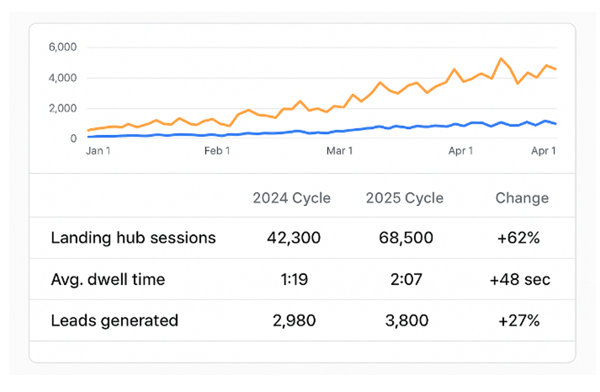
The campaign exceeded every target set at the start. The landing hub received a 62 percent increase in traffic compared with the previous cycle, with an average dwell time of more than two minutes.
Paid social activity delivered over 1.4 million impressions and generated 3,800 leads at a cost per lead 28 percent lower than the year before.
Email nurturing improved conversion from enquiry to application by 19 percent, and overall postgraduate applications for the 2025 intake rose by 14 percent.
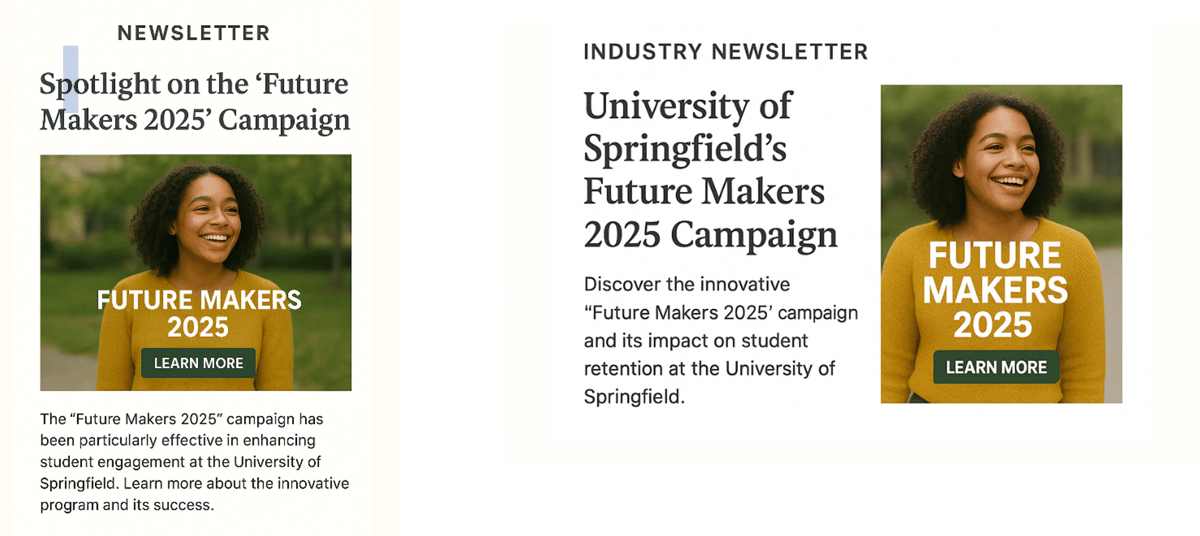
Qualitative feedback also highlighted the impact: applicants said the student stories felt “relatable” and “refreshingly honest,” and academic departments reported stronger engagement at offer-holder events. The campaign was featured in two sector newsletters and selected as a case study at a regional marketing forum, further supporting the university’s reputation for thoughtful, student-centred recruitment.
Supporting Evidence for Outstanding Education Marketing & Recruitment Campaign
Campaign: Future Makers 2025
1) URL for the campaign on our website - www.fakeuniversity.ac.uk/futuremakers
2) Link to our YouTube videos for the campaign - www.youtube.com/futuremakersfakeuniversity
3) Screenshot from Google Analytics dashboard showing 62% increase in landing hub traffic from Jan–Apr 2024 to Jan–Apr 2025.
- “The videos helped me finally picture myself doing a Masters. They felt honest and real.”
- “The emails answered questions I didn’t even know I had. It made applying feel less intimidating.”
- “I applied after seeing the STEM case study on Instagram. It gave me confidence in the career outcomes.”
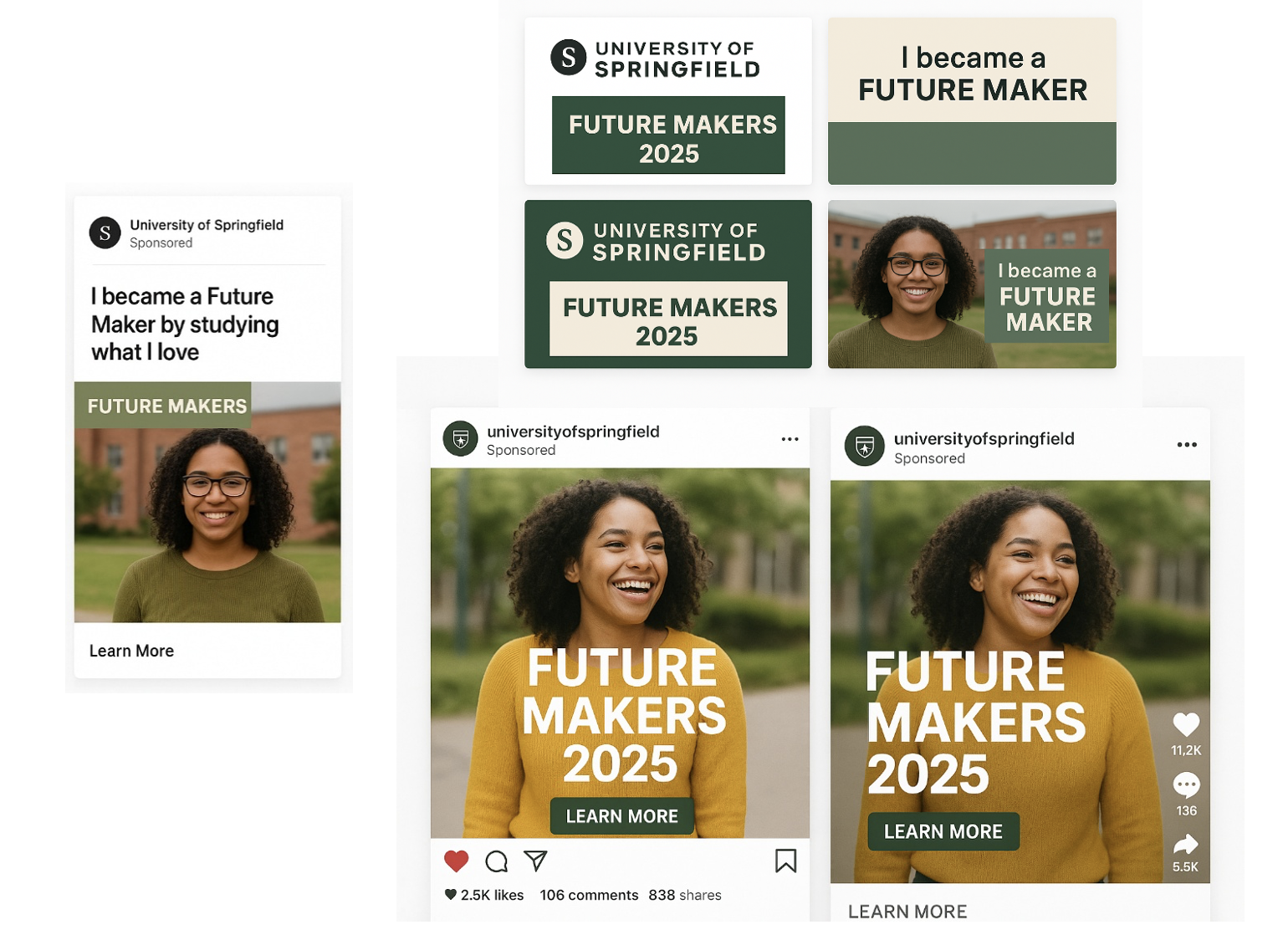
5) Example social creatives.
These highlight the campaign’s visual identity, messaging approach and student-led storytelling. This shows the creative strength and consistency across channels.
6) Influencer partnership report
This is a summary of outreach from alumni micro-influencers, including engagement metrics.
You can access this here (link to Google Drive)
7) External recognition
The campaign was featured in two sector newsletters and mentioned in a presentation at our regional HE marketing conference.
Photo from the conference:

Screenshots of the newsletters: